Annual Program Report

2025

Editorial

The year 2025 marked a consequential period for the social impact sector. Abrupt changes in the funding landscape, including the closure of multiple USAID supported programs, reshaped how portfolios were financed, governed, and sustained. The disruption was immediate and placed sustained strain on institutions and delivery partners across regions, including Papyrus.

For us, the defining challenge was not the disruption itself, but whether we could continue to deliver impact while adapting our operating model in real time without losing the confidence of partners and communities. Maintaining accountability and preserving trust under these conditions required that we make deliberate choices and execute them with discipline.

These dynamics were especially evident in fragile operating environments, including in Haiti where many of our programs are located. Political, security, and economic instability continued to shape how institutions functioned around us and how our services reached participating stakeholders and communities.

Across our portfolio of programs, 2025 became a year of recalibration. We adjusted our activities, evolved our partnership configurations, and refined our delivery models. It was edifying to see how these changes were driven by our strong partnerships with many of you, through our collective implementation experience, and not by abstract strategy. During this same period, Papyrus expanded its presence in Africa, reinforcing our regional engagement and signaling our sharpened focus on scale, strategy, and innovation even amid sector contractions.

As we look ahead to 2026 and beyond, the work documented in this report reflects a year in which new approaches were applied at scale, tested under strain, and refined through partnership. It demonstrated how intent continued to translate into delivery, and how we clung to our values of consultation, humility, optimism, trustworthiness, and impact in our decision-making. For our many colleagues and friends that lost their jobs and businesses this year, we look forward to hearing where you have landed, how you are faring, and how we can continue to collaborate going forward.

Alice Nkunzimana

Chief Executive Officer

A Global Portfolio in Practice

The following figures reflect cumulative engagement across Papyrus’ portfolio in 2025.

0

organizations supported through structured and tailored capacity accompaniment

0

individuals trained across governance, financial management, climate resilience, and enterprise development

USD 0 million +

in economic empowerment generated, reflecting total sales attributable to project-supported enterprises

0

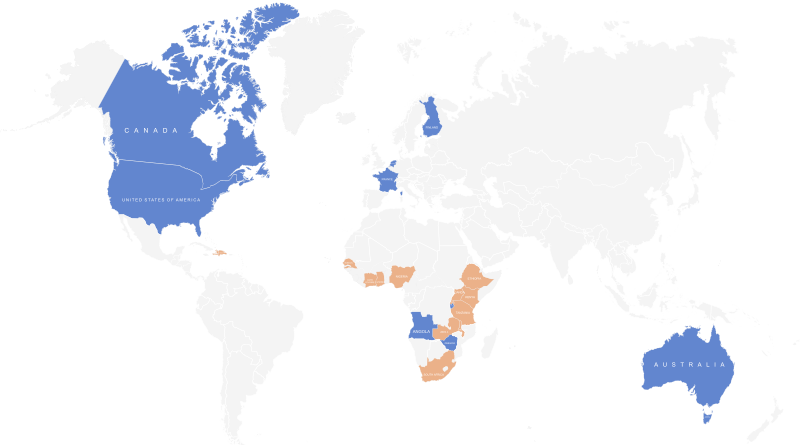
African service providers mapped and vetted across 16 countries to strengthen local capacity ecosystems

0

farmers trained in disaster risk reduction (DRR) and climate-related production mitigation

0 +

farmers adopting improved and environmentally sustainable production practices to strengthen adaptive capacity and long-term community resilience

0

youth ambassadors trained to support geo-referenced monitoring, resilience tracking, and data management through MAIS Mobil

0

multi-stakeholder sessions on market systems in agriculture

0

Community Disaster Contingency Plans implemented

0

thematic coalitions established and running

The Papyrus Promise™ - MAIS

Our Global Affairs Canada-funded Maize project concluded in 2025 after six years of implementation in southern Haiti. During that period, 4,050 producers were connected to structured markets, 4,916 commercial contracts were facilitated, and 72.1 million HTG (approximately USD 550,000) in sales were mobilized. The project supported the commercialization of 502 metric tons of maize and 80 metric tons of beans. Three Aggregating Buying Points (ABPs) were established as local market intermediaries, forming the institutional backbone of the commercial system MAIS was designed to build.

One year after closure, Papyrus conducted a structured follow-up assessment to examine which elements remained operational without project funding.

The commercial architecture remains active. All three ABPs continue purchasing from producers. Seventy-five percent of interviewed producers report that they are still selling through structured buyers. Shared equipment distributed during the project remains in use, and local partner organizations continue delivering services introduced during implementation. The system did not dissolve when funding ended.

Production practices show a more differentiated picture. Row planting has been fully retained among interviewed producers, indicating that practices requiring limited additional financial input have endured. Techniques that depend on sustained access to capital have declined. Eighty-seven percent of respondents report carrying active debt obligations, directly affecting their capacity to maintain input-intensive approaches. Sustainability, in this context, follows affordability.

Hurricane Melissa, in October 2025, affected every producer interviewed in the assessment. Half report that practices introduced under MAIS supported their recovery. This does not suggest full protection from shock. It does demonstrate that project-era investments provided measurable buffering under severe environmental stress.

The follow-up confirms that the institutional structures built under MAIS remain functional. Market intermediaries continue to operate, buyer relationships remain active, and coordinated sales channels are still in place. At the same time, producer-level financial vulnerability remains significant and constrains further gains.

The Papyrus Promise™ is measured not by activity during implementation, rather by whether systems endure beyond it. One year after project close, MAIS demonstrates that structured market coordination can persist under strain. The next phase of design will place greater emphasis on financial resilience mechanisms so that institutional durability and household stability advance together.

A Salute to our USAID-Funded Programs That Concluded in 2025

Kafe Tyòt se Richès (KTSR)

South-East

Supported the recovery of the Thiotte coffee sector by engaging 74 producers, strengthening organizations, and expanding private extension services to improve productivity and quality.

Livestock Profitability Support Program - PARE

South and North

Supported 559 farmers and agribusinesses to strengthen agricultural productivity and enterprise resilience through technical assistance, market linkage support, and institutional capacity building across 22 communes.

Livestock Profitability Support Program - PARE

South and North

Supported 559 farmers and agribusinesses to strengthen agricultural productivity and enterprise resilience through technical assistance, market linkage support, and institutional capacity building across 22 communes.

Resilient Landscapes Project – North - PPR-N

North

Supported community resilience in northern Haiti, with Papyrus leading environmental governance and engaging 164 local stakeholders across three sub-catchments.

Haiti Resilience and Agriculture Sector Advancement - HRASA

North

Strengthened community resilience in Haiti through inclusive market systems, with private sector engagement reaching 2,866 producers, service providers, and financial institutions.

Civil Society Strengthening Program - CSSP

National

Ninety-four civil society organizations implemented tailored administrative and organizational management (AOM) action plans, strengthening governance and financial systems. In addition, 24 CSOs and coalitions received structured advocacy training, contributing to improved strategic planning and policy engagement. Overall, more than 1,100 organizations engaged in collaborative platforms such as Haiti Soudé, advancing joint advocacy initiatives and participation in local governance.

Haiti Citizen Security Program - HCSP

Port-au-Prince

Supported citizen security and social services in two neighborhoods of Port-au-Prince, accompanying 14 community organizations through simplified grants and capacity building in high-risk urban contexts.

In 2025, six long-standing programs within Papyrus’ portfolio formally concluded following the end of USAID-supported funding.

These programs represented years of sustained collaboration with partners and communities across multiple contexts. While their closure reflected a broader contraction across the sector, the work delivered through them remains significant.

Papyrus recognizes the partners, teams, and communities who carried these programs forward and whose efforts produced lasting institutional and community-level outcomes beyond the life of the funding.

Kafe Tyòt se Richès (KTSR)

Supported the recovery of the Thiotte coffee sector by engaging 74 producers, strengthening organizations, and expanding private extension services to improve productivity and quality.

Livestock Profitability Support Program - PARE

Supported 559 farmers and agribusinesses to strengthen agricultural productivity and enterprise resilience through technical assistance, market linkage support, and institutional capacity building across 22 communes.

Resilient Landscapes Project – North - PPR-N

Supported community resilience in northern Haiti, with Papyrus leading environmental governance and engaging 164 local stakeholders across three sub-catchments.

Haiti Resilience and Agriculture Sector Advancement - HRASA

Strengthened community resilience in Haiti through inclusive market systems, with private sector engagement reaching 2,866 producers, service providers, and financial institutions.

Society Strengthening Program - CSSP

94 civil society organizations implemented tailored administrative and organizational management (AOM) action plans, strengthening governance and financial systems. In addition, 24 CSOs and coalitions received structured advocacy training, contributing to improved strategic planning and policy engagement. Overall, more than 1,100 organizations engaged in collaborative platforms such as Haiti Soudé, advancing joint advocacy initiatives and participation in local governance.

Haiti Citizen Security Program - HCSP

Supported citizen security and social services in two neighborhoods of Port-au-Prince, accompanying 14 community organizations through simplified grants and capacity building in high-risk urban contexts.

Papyrus’ Capacity Accompaniment Model™

At Papyrus, Capacity accompaniment is embedded directly into all our programs and is an integral part of our approach to everything we do. In 2025, we continued our work delivering capacity accompaniment to cohorts of organizations, including through our work with the Mastercard Foundation.

Participating organizations entered our accompaniment program with varying levels of institutional readiness. Papyrus supported structured their structured onboarding, conducted institutional assessments and co-developed capacity action plans for 160+ partners that translated findings into sequenced, practical improvements that which they participating organizations can accomplish on their own, with our assistance, or through the marketplace with our guidance.

As always, the objective is not to apply a one-size-fits-all approach, but to create coherence and to demystify the steps to organizational excellence. This year, our accompaniment services helped participants interpret funder requirements, prioritize actions, and strengthen internal systems while continuing to implement their programs in their respective communities.

Operating Between Funders, Partners, and Communities

In 2025, Papyrus expanded its work on partnerships. We find ourselves increasingly focused on working at the intersection of funders, program leadership, consortia, and impact organizations, each operating with different expectations, timelines, and constraints. Our role has increasingly been to design and support shared ways of working and to implement frameworks and guidelines that are instrumental in establishing systems for improved accountability, learning, and performance  in these social impact ecosystem actors.

We increasingly intervene from a “Program Operating Layer”, allowing us to participate in shaping how partners are onboarded within consortia, how to align protagonists’ expectations with operating realities, and how to make data accessible and visible to increase program efficacy and implementation speed.

We reinforced learning and performance visibility this year through Papyrus’ Capacity Accompaniment Model™ and Impact Dashboards, while our Running Start Package ensured rapid, aligned mobilization. These approaches are reflective of our sustainability commitment which is embedded in The Papyrus Promise™ we make to our clients.

As was the case for many of you, the year required significant internal adjustment. Fortunately, Papyrus had begun the process of increasing its operational efficiency by implementing the model in 2025 and was able to quickly apply the framework to restructure and sharpen our operating discipline during this period of sector-wide contraction. In parallel, Papyrus Growth Team worked with Alchemize It on new materials to clarify what makes our approach distinctive and where we want to focus our energies moving forward.

Papyrus expanded its global workforce formalizing regional leadership through the appointment of a Managing Director for Africa and onboarding four new Board Members. These structural investments strengthened oversight and positioned the firm to manage increasingly complex, multi-country portfolios.

Partnership in Practice: How Institutions Grow with Us

Institutional Milestones and Strategic Engagement

Throughout 2025, Papyrus remained actively engaged across the international development ecosystem.

The Discipline Behind the Work

2025 required clarity and sound judgment. Papyrus’ work across programs, portfolios, and partnerships depended on steady execution, even as conditions evolved.

In June 2025, Papyrus marked ten years of leadership by Chief Operating Officer and Board Treasurer Anouk Barrau Sassine, a decade that has coincided with the firm’s growth, increasing cross-border complexity, and portfolio transition.

Born and raised in Haiti, Anouk brings over 20 years of experience in audit, financial management, and institutional capacity development. A Certified Public Accountant, she joined Papyrus in 2015 and has shaped the operational systems that underpin the firm’s delivery model.

She ensures financial integrity, compliance, and disciplined execution across the multi-country portfolio. In moments of uncertainty or operational strain, she brings structure, clarity, and calm leadership, the steady line behind the firm’s commitments.

Her ten years reflect both professional rigor and sustained commitment to Papyrus’ accountability and long-term stability.

Anouk Barau Sassine

Chief Operating Officer